Several family members have described how the situation in the hospitals compounded their distress. Mr Devonside went from one hospital to the other in search of his son Christopher, seeing devastating scenes but not finding him.
Trevor Hicks attended the match with his then wife, Jenni, and two daughters, Sarah and Victoria. Mrs Hicks had a ticket for the North Stand; Mr Hicks and their daughters had tickets for the West Terrace, but he went into Pen 1 while Sarah and Victoria went to Pen 3. Both Sarah and Victoria were killed in the disaster.
After the match, Mr Hicks travelled from Hillsborough Stadium to the Northern General in an ambulance with Victoria, who was pronounced dead shortly after arriving. He was accompanied by a police constable. There had not been room for Sarah in the ambulance, and Mr Hicks had been faced with the awful dilemma of having to leave her on the pitch, on the assurance that she would be placed in the next ambulance.
A short time after they arrived at the hospital, the PC informed him that Victoria had died. Mr Hicks then began to search the hospital for Sarah, who he assumed had arrived soon after. After an hour and a half of searching and waiting, he was taken to the section of the hospital where those who had died were being attended to and gave a description of Sarah to the police officers on duty there. He explained that the officers told him there was a young unidentified female and brought out a watch to show him. He thought it may have belonged to Sarah and said that after about 10 or 15 minutes he was taken to the hospital mortuary to identify the young woman. He expected this to be Sarah, but in fact, it turned out to be Victoria.
He said that he returned to the main hospital building for another half hour or so, during which time he was trying to find both Jenni and Sarah. He was told that some casualties had been taken to the Royal Hallamshire, but he could not get through by telephone. At about 6pm, he was taken to the Royal Hallamshire, where he gave Sarah’s description to staff who checked to see if she had been admitted.
At about 8pm, he returned to the Northern General where he was reunited with his wife. He was appalled to learn that she had been told Victoria had died but had been refused permission to see her. He explained that his wife was distraught when he told her he had been unable to find Sarah. Mr and Mrs Hicks later identified both their daughters at the gymnasium.
Dolores Steele went to the Northern General with her husband Leslie in search of their son Philip, who died in the disaster. In a statement made in 2014, she recalled that on her arrival at the hospital, she gave her details to a member of staff and was told to sit down and wait. She said that a man in a white coat stood on a table and read out the descriptions of ten people who had died, and that the penultimate description referred to a person in possession of a signet ring engraved with initials. Philip wore such a ring, but the initials were given in the wrong order. She insisted that she was allowed to see the ring, and a police constable went to get it. Mrs Steele said: “I knew it was Philip’s ring before they took it out of the bag”.
She was told her son was in the hospital mortuary and the police constable took her there. They sat outside and waited for what she believed was over an hour, only to be informed that her son was no longer at the hospital, and that he had been taken back to Hillsborough Stadium. She commented: “It just all seemed to be hopeless”.
The officer involved had no idea that this was happening and was hugely embarrassed and apologetic. Mr and Mrs Steele identified Philip at the gymnasium later that evening.
The majority of those injured in the disaster, and a number of those who died, were taken by ambulance directly from Hillsborough Stadium to the nearest two hospitals: the Northern General (2.4 miles from the stadium) and the Royal Hallamshire (2.7 miles). A very small number of those injured in the disaster attended Barnsley District General Hospital. Each hospital implemented its own Major Disaster Plan before 3.45pm on 15 April.
Numerous family members and friends travelled to the hospitals, either to look for loved ones who were missing or to wait for news of those who were being treated. However, as in other locations, they encountered chaotic scenes and ongoing difficulties in getting accurate information about casualties.
This was exacerbated by the scale of the disaster. Within the first hour after it was notified of the disaster, the A&E department at the Northern General received 87 patients. A&E consultant James Wardrope confirmed this was more in an hour than it would normally receive in half a day. Of these, 17 were admitted to intensive care, again in the first hour. By comparison, in a routine 24-hour period, an average of 15 patients would be admitted to intensive care.
In some cases, mostly through the efforts of hospital staff and volunteers, families and friends did receive updates. This was largely in relation to those being treated for less serious injuries, who would have been able to provide staff with their names and details.
By contrast, some of the more severely injured were rushed into operating theatres for emergency surgery or placed in intensive care, without going through normal admission procedures. The need for an immediate medical response on unconscious patients meant that few if any details were documented. As a consequence, there was little information available about many of those who were critically ill.
The responsibility for providing information did not lie with the hospital staff: it was the role of the Casualty Bureau and the police more widely. The SYP Major Incident Manual reflected this, clearly instructing that when a Casualty Bureau needed to be set up in response to a major incident, police officers would be dispatched to hospitals. It stated: “The prime task of the hospital liaison officer at the hospital is to obtain and transmit information from the hospital to the Casualty Enquiry Bureau so that relatives and friends may be enabled to identify and trace injured persons as soon as possible. The second, but equally important task is to provide a line of communications between the hospital and Force Operations Room, and hence to the scene of the incident.”
The evidence indicates that this guidance was followed on 15 April 1989. Around the same time that the Casualty Bureau was activated, teams of police officers were deployed to relevant hospitals to act as liaison officers.
However, the liaison officers’ effectiveness was limited, in part due to communication problems with the Casualty Bureau, but also due to an apparent confusion as to their role.
One officer at the Northern General recalled that he was unable to assist much. He stated that he tried to call the gymnasium to help answer questions from families but struggled to get through. He did not mention contacting the Casualty Bureau.
The officer in charge of the police team at the Northern General, Insp Bennett, said that their role was to collate information about the injured and pass it to the Casualty Bureau. In a statement to Operation Resolve in 2013, he said that they “were not concerned about identification at that stage”, and the only way they could have identified those who had died would have been from information passed by the hospital staff. He added: “It was not our role to search any personal property or remove clothing.”
However, members of his team had a different view and described their involvement in exactly these tasks. They noted, however, that very few identifying documents were found.
Volunteers who went to assist at the hospitals, and some family members, have said they didn’t see police officers at all. It appears officers sought to work behind the scenes, but this added to the confusion and volunteers decided to do what they could independently.
Vicar Roger Atkins was directed to the Royal Hallamshire by police so he could assist. Having arrived at the hospital, he went to the waiting area with other volunteers. In a statement made in 2015, he said: “I eventually got tired of waiting for further instruction on what was required from us. I decided to go to the wards where the casualties from Hillsborough were situated. I found out where they were located by asking hospital staff.”
In a statement made in 2016, volunteer Amanda Mills explained that she went to the Royal Hallamshire from the Boys’ Club with a list of names to look for. She said that when she arrived, the hospital reception was “…packed with people trying to find information about missing persons from Hillsborough. Members of staff in the hospital were dealing with requests from people shouting out names of those they were trying to locate.”
With the help of a receptionist, she managed to locate the people she was looking for, then returned to the Boys’ Club to pass on the positive news. She made three similar visits to the hospital and said that as far as she could recall, she found everyone she was looking for. She did not mention any police officers being present at the hospital.
Brian Ibell was Assistant General Manager at the Northern General. In a statement to Operation Resolve, he described how he gathered available information about those who had died and the injured and then went to the canteen area to speak to the families. He recalled that he introduced himself, explained what information he had and told the people there that he would return to the canteen every two hours or so to update them. He said that as the police passed him information, he stood on a table to address the relatives. He said that by the early hours of the morning, there were 200–300 people present. He recalled speaking to the friends and families about seven times in that way throughout the day and night.
At a certain point in the evening, Dr Popper issued an instruction that all those who had died be transferred from the hospitals to the gymnasium for the formal identification process. This transfer commenced without informing relatives who were waiting for news of their loved ones, causing considerable upset. While the decision was made by Dr Popper, there was scope for the police to challenge the decision or at least mitigate the worse effects through better communication and coordination. The fact that the police at the hospital were taken by surprise by the decision reflects the lack of communication and coordination that typified the wider operation after the disaster.
For families and friends waiting at the Boys’ Club and the Church Hall, the organisational issues came very much secondary to a bigger concern: the difficulty in getting accurate and timely information about their loved ones.
At both locations, information came through slowly and was often piecemeal. Various accounts have highlighted that for some, family members at home proved more valuable sources of information than the police or those who appeared to be in charge at the Boys’ Club.
Francis Molloy attended the match with his nephew and two of his nephew’s friends: Ian Glover who died in the disaster and Ian’s brother Joseph. Mr Molloy was seated in the North Stand; his nephew was in the West Stand and Ian and Joseph Glover were on the West Terrace. Unable to find them, at around 5.45pm, he went to what he described as a temporary incident office at the far end of the North Stand, where he asked police officers for information.
He said that the officers told him to take a special bus, and he made his way to Hammerton Road Police Station, where he provided details of the three, and then went to the Boys’ Club. He said that everybody there was helpful, but he had no information so didn’t phone home. He recalled that at about 7.30pm, a number of people started arriving from Liverpool and he became aware of the full extent of what had happened.
A member of the clergy took him to an office and allowed him to use the phone. He spoke to his sister, who told him that his nephew and Joseph Glover were in hospital, but that Ian had died.
Alan Billings was an Anglican priest and SCC councillor. He initially attended Hammerton Road Police Station at about 5.20pm in response to a local TV news appeal for social workers to make their way there, and soon after went to the Boys’ Club. On 17 April 1989, an article in his name was published in the Sheffield Star, a local newspaper in the city. In it, he described accompanying the parents of a 21-year-old man while they waited for information at the Boys’ Club. The parents had spoken to friends of their son and were aware that he had been hurt but did not know where he was.
After about three hours, their other son, who was at home in Liverpool, told them he had heard from a hospital in Sheffield that their missing son was there. Mr Billings accompanied the family to the Northern General. However, on their arrival, hospital staff were unable to locate their missing son. They telephoned home again and discovered that a friend of their son had driven him home.
Christine Milnes was a social worker based at Weston Park Hospital in Sheffield. In a statement made in 2016, she described how she made “several trips to the Northern General Hospital and the Royal Hallamshire hospital with people trying to locate their friends and relatives. After taking people to the hospitals, I returned to the boys club to try to help others looking for missing friends and relatives”.
The very fact that families were having to travel to hospitals to look for loved ones demonstrates the lack of information that was available at the reception centres—something that frustrated police officers on duty too. Superintendent Derek Sleath (Supt Sleath), who had gone to Hammerton Road Police Station as soon as he heard of the disaster, commented that most of the communication between sites “was done by me walking or driving round.”
Though the information flow overall was slow, some recalled one incident at the Boys’ Club when a police officer read out a list of names of people who had been found safe and well. However, this list included the name Adam Spearritt, who it was later confirmed had died in the disaster.
Adam was 14. He and his father Edward had both been reported missing by friends who had gone to the match with them. When the friends were told Adam was safe and well, they telephoned his mother to let her know. The volunteer church worker who had been assigned to support them also recalled this happening. Further, the uncle of another young man who died in the disaster has also stated he heard a police officer announcing that Adam was alive and well.
Other witnesses also recalled a list of names being read out but did not remember any specific details; a further group said they had no recollection of a police officer reading out a list of names.
All of the police officers present have said they did not read out any lists of names. Supt Sleath specifically stated that they decided not to read out any lists of names of casualties but instead used the volunteers and support workers to inform families individually. Insp Hogan-Howe recalled that they did eventually obtain a list of people who had gone to hospital, but that he didn’t remember him or anyone else reading it out.
Raymond Cooper was Chief Assistant in the SCC Family Services department. He took a lead role in organising the support at the Boys’ Club, and lots of witnesses recall some interaction with him.
In a 1989 statement, he said that sometime during the evening, the police gave him a “list of fatalities” and a list of people who had been arrested in and around the ground. He agreed with the police that they would use these to approach families and friends individually and sensitively.
Conversely, in a 2014 statement to Operation Resolve, he said he only recalled the list of people arrested and had no memory of a list of those who died, adding that they couldn’t have been identified at that stage. He was adamant there was no other list, such as of those who had been found safe and well.
The only individual who has said that they read out a list at the Boys’ Club is social worker manager Kevin Ashby. In a statement to Operation Resolve in 2016, he said that “Within minutes of entering the Boys Club I was presented with a megaphone and a list of names with no clear instruction of what to do with them. I can’t recall who presented me with the megaphone and the list of names. In relation to the list of names, I did not recognise the names and assumed it was a list of Liverpool fans names.”
Someone then gave him a name; he saw it was on the list and called it out. He said he was subsequently informed that rather than doing this, he should have matched that name with a social worker.
Overall, the evidence about the reading of a list of names is inconsistent, in terms of what lists were circulating and how they would have been handled. Nonetheless, some of those who were at the Boys’ Club have a vivid memory of a list being read out and in particular that Adam Spearritt was declared as being safe and well. Understandably, the later discovery that this information was incorrect was devastating.
Almost immediately, large numbers of people began to arrive at the Boys’ Club. As well as families and friends trying to find information about loved ones, many social workers, faith workers and volunteers turned up, having responded to calls for assistance.
Accounts indicate that initially the scene was chaotic, but gradually the volunteers and care professionals created some order and provided a range of support services. Arrangements were made for a psychiatrist and psychologist to set up a bereavement counselling service in a quiet room upstairs, and the Women’s Royal Voluntary Service (WRVS) arrived to provide refreshments. Each family group had one or two professionals or volunteers allocated to them.
The evidence strongly indicates that the police played little or no role in making these arrangements and had very little interaction with the families and friends waiting at the Boys’ Club. Inspector Bernard Hogan-Howe (Insp Hogan-Howe) was the senior police officer there; in a statement to Operation Resolve, he confirmed he mostly spent his time upstairs in the office, attempting to get information from the hospitals and other locations.
There were well over 200 people there at some points, making the environment extremely noisy. As the Boys’ Club became increasingly busy, a second reception centre was opened at around 5pm. This was at St John the Baptist Church Hall on Forbes Road, about 0.2 miles from the Boys’ Club. The facilities there were more suitable. Again, the organisation of support was left to social services and volunteers, with little police involvement.
Later in the evening, steps were taken to differentiate the use of the Church Hall from the Boys’ Club, with the Church Hall being used to provide additional support for family members and friends who had identified their loved ones at the gymnasium and were grieving. The Boys’ Club was then used for those who were still waiting to go to the gymnasium or hear news about their loved ones.
Additional locations were also identified to offer further support to families, including facilities where people could sleep overnight. In the end, these were barely used.
From about 9.30pm, groups of those waiting at the Boys’ Club were taken by bus to the gymnasium to begin the formal identification process. Many families and volunteers have said that they were not given any details of what they were about to experience at the gymnasium.
The operation at the Boys’ Club closed down in the early hours of 16 April. The Church Hall stayed open for a few hours longer.
Hammerton Road Police Station was the closest police station to Hillsborough Stadium, just over a mile away. SYP initially directed friends and relatives searching for their loved ones to wait there; from about 4pm, the station also became the designated point for reporting someone missing. This was in line with guidance in the Major Incident Manual to find a suitable location away from the incident.
On arrival, relatives and friends were taken into the CID office, where a team of officers filled out missing person forms. Standard SYP forms were used for this, rather than anything specific for the purpose. Once completed, the forms were intended to be delivered to the Casualty Bureau, set up to coordinate information about all those injured or missing. This was a logical and reasonable process for SYP to adopt. However, communications were poor: forms could not be faxed over at first, and the telephone lines to the Casualty Bureau were constantly busy. Some forms were taken by a police motorcyclist.
More than 120 such forms were completed, but they appear to have had minimal impact on the identification of any of those who died, as completed forms did not reach the Casualty Bureau fast enough to help. There is evidence to suggest that, in some cases, officers sought to provide information immediately on completion of the form. However, in most cases they were unable to do so, because they had no information themselves.
As the number of people looking for loved ones increased, Hammerton Road Police Station became overwhelmed. Alongside acting as a centre for those waiting for information, as well as those reporting someone missing, it was also the meeting point for police officers responding to the disaster and a location for SYP’s Major Incident Room (MIR). Once support workers and volunteers started turning up to assist families and friends, there was not enough room.
At about 4.15pm on 15 April 1989, the Hillsborough Boys’ Club was opened to serve as a reception centre for people waiting for information. Once a missing persons’ form had been completed, the friends or relatives were directed to the Boys’ Club, reducing the pressure on Hammerton Road Police Station.
The Boys’ Club was almost next door to the police station. It was also a large space and not in use for any other purpose. A member of the clergy who had arrived at Hammerton Road Police Station was able to open it so that it could be quickly put to use.
However, facilities there were limited. There were insufficient chairs for the number of people, poor toilet facilities and only one working telephone until more were installed later in the evening.
A number of family members have raised concerns about how police officers treated them at the gymnasium, commenting that as they went there to look for their loved ones, some police officers prevented them from entering and did not provide them with any information.
Kevin Thompson went to the game with his brothers Patrick, who was killed in the crush, and Joseph. He said that after police officers had carried Patrick to the gymnasium, “They put him on the floor and left me with him. I was screaming and shouting.” He added, “I just wanted to hold on to Pat because there was nothing I could do. The police made me leave and we were taken to the police station and then sent home.”
Stephen Jones’s wife Christine was also killed in the disaster. He had been separated from her in the crush and eventually made his way onto the pitch, where he found her lying on the touchline and instantly knew she had died. With assistance from Police Sergeant Julian Roper (PS Roper) and other officers, Mr Jones carried his wife to the gymnasium, where he sat with her and held her.
In a statement to the IOPC in 2015, he described a series of rude and inappropriate interruptions and interventions from police officers, after the third of which he became so frustrated at the way he was being treated, he kicked out at a chair. Two police officers took hold of him and told him to calm down. He commented that other than PS Roper, nobody had shown him any compassion, nor seemed to care or understand.
Barry Devonside’s son Christopher was killed in the disaster. They had gone to the match together. Mr Devonside was seated in the North Stand, while Christopher went to the West Terrace.
In a statement to solicitors dated 1 August 2014, Mr Devonside said that he left the ground at 3.45pm following an announcement that the match had been cancelled and returned to the group’s prearranged meeting place. When he got there, one of his son’s friends told him that Christopher had died and was in the gymnasium. Mr Devonside said that he got directions to the gymnasium and arrived there between 4pm and 4.15pm.
He knocked on the gymnasium door and waited for a long time for it to be answered, only for a police officer to ask him without any empathy, “What do you want?” Mr Devonside explained what he had been told and the officer asked for his son's name. Mr Devonside recalled, to try and help identify Christopher, that he also told the officer that his son was wearing a Welsh international rugby shirt.
The officer told him to stay outside, then closed and locked the door, returning 10–12 minutes later with the news that his son was not there. Mr Devonside said that he told the officer his son had to be in the gymnasium, as his friend had carried him there and had given his full name and address to the police. However, the officer said, “I have just told you he's not here”.
In 2014, he made a complaint about the manner of the police officer concerned. Operation Resolve investigated this complaint. Though it was not possible to confirm the identity of the officer involved, the IOPC upheld the complaint, on the basis that because the officer “spoke to Mr Devonside in an abrupt, unsympathetic and unprofessional manner”, Mr Devonside did not receive the level of service a member of the public might reasonably expect.
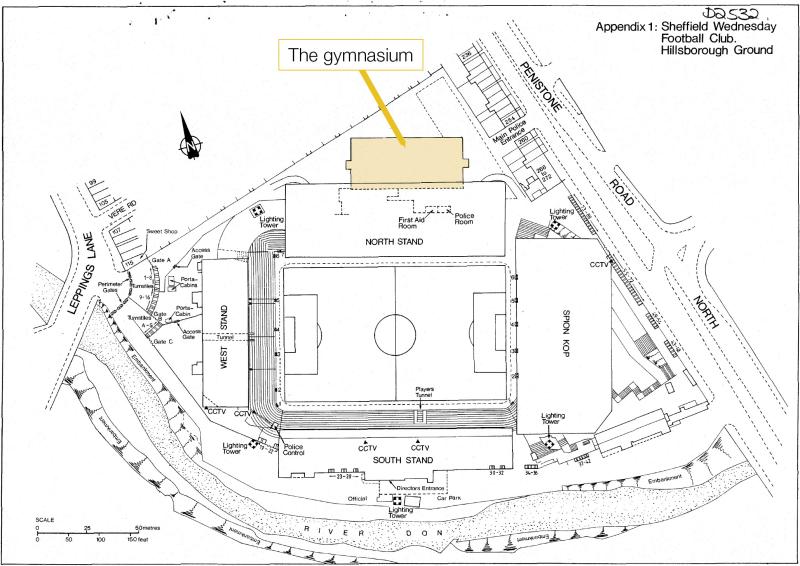
The gymnasium at Hillsborough Stadium was a purpose-built sports hall, situated at the back of the North Stand, as shown in figure 6A.
Image
Figure 6A: Map of Hillsborough Stadium showing the location of the gymnasium (Source: SYP Archive)
After the disaster, the gymnasium almost immediately became a focus of activity. For several reasons, it had been pre-identified as a place to take casualties if needed: it was accessible from the pitch, via the path between the North Stand and the Spion Kop and had some (albeit rudimentary) facilities. It had also been pre-identified as a suitable location for a temporary mortuary if one was needed, and again it fulfilled relevant criteria for this purpose. It had good access from the road and was away from public view. There was also a telephone in the adjoining police room.
On the day of the disaster, many police officers were already in the gymnasium. Some were on standby, others were completing paperwork relating to arrests they had made, and some were having a scheduled refreshment break. Several have said that shortly after 3pm, Ch Insp Beal came in and shouted for the area to be cleared. Some recalled him explaining that it was to receive casualties, while others recalled him saying that it was to be used as a mortuary.
The situation there quickly became chaotic and its use as both a first aid centre and mortuary became untenable as the number of those who had died increased. There was a lack of preparedness and limited control and coordination across agencies. This reflected the fact that although the gymnasium had been selected as a suitable temporary mortuary location during a multi-agency meeting in 1986, no detailed consideration had been given to how this would work in practice. There was minimal medical equipment on site and there was no guidance in the Major Incident Manual, or anywhere else, about the possible layout of a temporary mortuary in the gymnasium. SYP had major incident boxes, which included essential documents setting out clear processes for responding to such an incident and standard forms. These were located at key locations across the force area; however, they did not have one at the stadium, so one had to be brought from a police station.
Numerous practical issues emerged, most obviously the need to separate those who had died from those requiring and receiving treatment. There were also no protocols for attending to bereaved family members who had accompanied or followed loved ones into the gymnasium. Advertising hoardings that had been used as stretchers had been left in the gymnasium so that those who had carried them could quickly return to assist more casualties. However, as the number of hoardings left behind increased, they became obstacles.
There was also a procedural requirement to address body continuity: the process by which police officers and others ensure that, as a body is moved, identified and where necessary examined, all those involved are dealing with the same individual. Normally, the first police officer to attend would stay with the person who has died, but after carrying people to the gymnasium, officers returned to help with the rescue effort.
Once this was recognised, officers were instructed to write their collar number on the hand of the person who had died, before returning to the pitch.
Shortly after 4pm, D Ch Supt Addis arrived, having received instructions from ACC Jackson to ensure the temporary mortuary was functioning. He took charge of the situation there, putting in place processes for documenting details of each of those who had died. He also ensured that Dr Popper had been contacted and directed that officers be placed at the entrance to restrict access to the gymnasium. These actions brought some order to the situation.
D Ch Supt Addis has stated that his main priority was to maintain continuity of the identification and movements of those who had died. However, because identification was the responsibility of the Coroner, D Ch Supt Addis was unable to start a formal process. In the interim, he could have focused on other tasks to make the response more coordinated and effective and to consider the needs of families and friends.
Dr Popper was told about the disaster by 4.15pm; he was at home at the time. Having been given enough information to understand that a large number of people had died, he telephoned key colleagues, then went to the MLC, where he arrived at about 5.40pm. He met with a group of pathologists and coroner’s officers to discuss options for the coronial response to an incident of this scale. With a smaller group of colleagues, he then went to the stadium to assess the situation. He had no direct contact with D Ch Supt Addis or anyone else in the gymnasium before he arrived at the ground.
Concerns about the way family members and friends of those who died were treated were first raised publicly within days of the disaster. They have been acknowledged in different arenas since, from media coverage to formal reports, and a range of issues related to the treatment of families and friends have been identified. These included:
the suitability of the premises SYP used, from the gymnasium at Hillsborough Stadium which served as a temporary mortuary, to the locations used as reception centres
the treatment of family members and friends in the temporary mortuary
the fact that those who died at the hospitals were transferred back to the gymnasium for identification
multiple aspects of the identification process, including the long delay before the process started and the fact that it then took a very long time and was poorly managed and insensitive, in particular through the use of distressing photographs as a first step
the inconsistent and insensitive care and handling of those who died, including that in some cases, their faces were washed before they were photographed and the fact that police officers’ collar numbers were written on some of the bodies
the insistence on adhering to the formal identification process for all of those who died, even when some had already been identified by a friend or family member earlier on, and the fact that personal property and distinguishing features were not used to help in the identification process
the fact that some of those involved in identifying a loved one were under the age of 18 and did not receive appropriate support
the manner in which police officers questioned family members and friends after they had identified a loved one—in particular, that they asked about alcohol consumption and the possession of match tickets, neither of which was relevant to the identification
the overall lack of information provided to families and friends both in Sheffield and remotely, and the quality, accuracy and timeliness of the information that was provided
that family members were prevented from touching, holding or kissing a loved one
several families specifically recalled being told that those who had died were “the property of the Coroner”: this issue—which was brought to widespread public attention in the 1996 docudrama ‘Hillsborough’ and covered further in the HIP Report—was the source of a number of complaints investigated by Operation Resolve
The concerns about the identification process applied to identifications made in the gymnasium and at the MLC. Other issues were broader and applied to the entire experience.
Once they were rescued from the crush on the West Terrace, injured supporters were taken to a range of locations including the gymnasium at the stadium, which was designated as both the place for medical treatment and the temporary mortuary on site, and to Sheffield’s two major hospitals, the Northern General and the Royal Hallamshire.
Within minutes, it was apparent that some of those being carried to the gymnasium had died. From about 3.15pm, the gymnasium became both a casualty clearing point and the temporary mortuary, with the injured being treated in a separate area of the main hall. Those who were pronounced dead by medical professionals on the pitch were also taken to the gymnasium. They remained there until they were identified.
At about 6.45pm, Dr Popper attended the gymnasium and agreed a formal identification process with Detective Chief Superintendent Terence Addis (D Ch Supt Addis), the head of CID at SYP. As part of this process, Dr Popper instructed that all those who had died in hospital must be transferred back to the gymnasium for identification.
By about 9.15pm, 93 of those who had died were at the gymnasium ready for the formal identifications to begin. This commenced about 9.30pm. Just after 10pm, the 94th of those who died on the day was brought to the gymnasium from the Northern General.
Under the agreed process, a photograph was taken of the face of each of those who had died. These photographs were taken using Polaroid cameras so that they could be printed instantly. They were then displayed on boards. In small groups, the family members and friends completing the identification were brought into the gymnasium to look at the boards and asked if they could see their loved one. When they recognised them, the photograph was removed from the board, and the corresponding body was brought by police officers into a small, curtained area for viewing; the family members and friends had to then confirm the identity of their loved one.
The family members and friends were then taken to a different area of the gymnasium where they gave police officers a formal identification statement. It was during this point that some have said they were asked about their or their loved one’s alcohol consumption.
Once a friend or family member had formally identified their loved one, the body was taken by ambulance to the MLC, which was the city mortuary in Sheffield, for a post-mortem examination. By early next morning, the majority of those who died had been identified and transferred to the MLC. A decision was made that anyone who had yet to be identified would also be taken to the MLC and identified there.
A police officer was assigned to stay with each of those who had died for the whole time, in line with a process known as ‘body continuity’. The officer could then confirm that it was the same individual the family had identified, and that there had been no unauthorised contact with them. At the MLC, the officer formally handed responsibility for that individual to the officers on duty there.
By 6.30am on 16 April 1989 the operation inside the gymnasium was closed down. Later that day, post-mortem examinations began at the MLC in line with Dr Popper’s instructions. They were concluded by 2pm on 17 April 1989.
Throughout this period, the situation was both distressing and extremely confusing for friends and family members. Some groups who had travelled to the match together did not have tickets for the same section of the ground, while many of those who did have tickets for the same area had become separated, whether during the crush at the turnstiles on entering the ground, during the crush on the West Terrace, or following their escape from the pens. While some were later reunited on the pitch or on their return to their pre-arranged meeting points, others were frantically searching for their companions and trying to obtain information. Mobile phones were not widely available at the time, so friends and family members had to rely on snippets of information they could get from others—including police officers on duty at the stadium—about where casualties may have been taken.
When this failed, the next course of action was to head to the nearest police station, Hammerton Road, to report their loved ones missing. Some then went to the hospitals, going from one to the other in the hope of finding information.
Many of those who had not been at the match attempted to contact SYP and Merseyside Police by phone, using dedicated Casualty Bureau numbers that were broadcast on TV and radio. However, the sheer number of calls meant that it was difficult to get through and speak to anyone; when calls were answered, the call handlers had little information to give. Many families then made the decision to travel to Sheffield, again trying hospitals but in many cases ending up anxiously waiting for information in various locations around the city that had been hurriedly transformed into reception centres. Those who had been at the game also gravitated to these same locations, typically deeply traumatised by their experiences that day. A large number of social workers, members of the church and other volunteers accompanied and supported the families and friends at those locations.
The main reception centre was at Hillsborough Boys’ Club, a youth club close to Hammerton Road Police Station, which had limited facilities and offered little or no privacy. While there was some support available for the families and friends, the thing they wanted most—information on their loved ones—was in short supply. In some cases, when information did come through, it proved to be inaccurate.
Once the identification process had been determined, families were taken by bus to the gymnasium to identify their loved ones. For many, this involved a long wait outside the gymnasium before they were even allowed in, as the numbers of those inside were carefully controlled. Others simply had to wait in a state of increasing apprehension at the reception centres for the next bus.