Up to at least 1pm, the number of supporters in the vicinity of the stadium was quite small, despite advance efforts by SYP to encourage people to enter the ground early. These included messages in match programmes at preceding home games of both teams and a promise of pre-match entertainment in the stadium (which did not take place).
The first cars and minibuses carrying Liverpool supporters began to arrive shortly after 11am, and the first coaches arrived in designated coach parks at around 11.45am.
After the disaster, a persistent theme in police officers’ accounts was that supporters travelled to Sheffield early and then went to pubs or bought alcohol from shops. Evidence from a range of sources strongly indicates that there was nothing out of the ordinary about this. The licensee of a pub a short distance from the stadium—The Horse and Jockey—confirmed he was expecting to be busy with football supporters.
The likelihood of supporters drinking featured in numerous police briefings and instructions. For example, Serial 48 under Police Sergeant Derek Miller (PS Miller) had instructions to pay particular attention to licensed premises in the Wadsley and Middlewood areas. In a statement to Operation Resolve, PS Miller confirmed that they started patrol at 11.30am and visited several pubs which were busy with Liverpool supporters. He described them as being in “high spirits” but presenting no problems.
Though there were instructions to “pay attention”, there was no direction within the Operational Order about how to deal with supporters drinking: a clear oversight given its likelihood.
Some 52 coaches of Liverpool supporters arrived between 12.30pm and 1.45pm. Some of those who travelled by coach went directly to the stadium; others felt it was too early, so chose to go for a drink. As the available pubs were mostly full, some bought drinks from shops instead.
Image
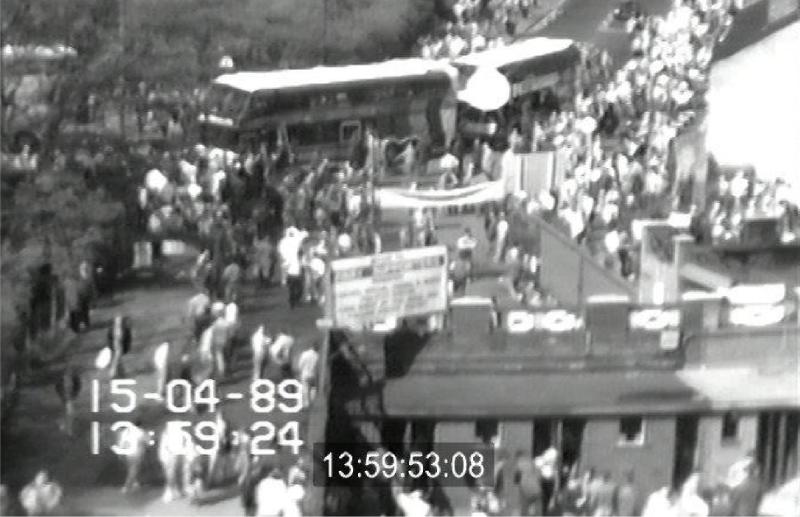
Figure 4B: View of Leppings Lane and the entrance at 13:59:53 (Source: SYP CCTV)
From around 1pm, the numbers of supporters at the ground steadily increased. Figure 4B shows the scene at the Leppings Lane entrance at 13:59:53. It is taken from SYP CCTV footage, which would have been visible to those in the PCB.
While the situation at the entrance presented no issues, various witnesses have commented on how empty some of the areas of the stadium allocated to Liverpool supporters were at this time. Inspector Peter Darling (Insp Darling), on duty in the South Stand, visited the SWFC control room around this time. He told the Taylor Inquiry that someone in the control room had noted there were only 12,000 people inside the ground at that stage, compared to 20,000 at the same time at the previous year’s Semi-Final. This information would have been based on turnstile count data, which was displayed on a screen in the control room. However, Insp Darling did not mention this to the PCB and there is no evidence to indicate that anyone in the PCB actively requested this potentially invaluable data.
Some officers have since acknowledged that, if they had known how few supporters were in the stadium at 2pm, they would have been concerned.
The turnstiles were scheduled to open at midday ahead of the 3pm kick-off. Officers on duty at or around the stadium attended a 10am briefing in the North Stand, led by Ch Supt Duckenfield. He used exactly the same briefing notes as he had for his briefing of senior officers the previous day.
The evidence of officers present suggests there was nothing particularly remarkable about Ch Supt Duckenfield’s briefing. Following it, there was a series of sector and serial briefings, with more detailed instructions about the duties of individual officers. The majority of these were as officers expected, but a small number of discussions appear to have been significant.
Supt Greenwood, as ground commander inside the stadium, briefed officers on duty at the Spion Kop (the terrace allocated to Nottingham Forest supporters) about how they should deal with any Liverpool supporters that had bought tickets for that area. He instructed officers that any Liverpool supporters there should remain in a segregated area on the Spion Kop and not be transferred to the Leppings Lane end of the ground. This instruction was different from what was set out in the F Division Operational Order, in which officers were told to transfer Liverpool supporters found in the wrong area to their own designated area. Supt Greenwood did not want to do this, because he was concerned that it could result in overcrowding on the West Terrace, as had occurred at the 1981 Semi-Final.
Despite this concern and other instances of overcrowding on the West Terrace, no officer appears to have given, or received, a direct instruction during a briefing to monitor capacity in the pens there. As no instructions to this effect were included in the F Division Operational Order either, no officers anywhere in the stadium were told that they had a responsibility for monitoring the pens. Ch Supt Duckenfield and other senior officers have all stated in evidence that they understood officers in certain areas of the ground had that responsibility.
There were separate briefings for D Division, who had commenced duty earlier in the city centre, and for the Dog and Mounted Sections, both of which were briefed at the Niagara Sports and Social Club, where they were based, a short distance from the stadium.
Ch Supt Duckenfield arrived at the Niagara Club before the Mounted Section had left, at around 11.30am. He spoke briefly to the mounted officers to wish them well.
This is one of few clear details about how Ch Supt Duckenfield spent the time between the end of the 10am briefing and his arrival in the PCB at around 1.50pm. Ch Supt Duckenfield’s own accounts are vague on what he did in this period. Operation Resolve has used multiple sources of information to re-examine this issue, drawing together the accounts of different officers, witnesses at different venues and locations, and some AV material.
Some evidence indicates that Ch Supt Duckenfield toured the area in a police car with Insp Sewell and then went around the stadium—though there are few witnesses to this latter part. It appears they then went for lunch in the gymnasium at around 1.30pm.
Partly because his accounts are so vague, questions have been asked about what Ch Supt Duckenfield did during this period, and it has been alleged that he could have drunk alcohol during this time. Operation Resolve has found no evidence to indicate he (or any other officer on duty at the match) did so.
Nonetheless, the evidence gathered by Operation Resolve demonstrates that Ch Supt Duckenfield’s activities and movements in this period lacked the focus and purpose that would be expected of a match commander. He did not use the time after the pre-match briefing to familiarise himself with the important areas of the stadium, to talk to officers on duty in different areas about their knowledge of previous issues and risks, or to gather their observations on the arrival of supporters.
Ch Supt Duckenfield subsequently acknowledged that he was not sufficiently aware of the structures of the stadium or the facilities available to him to be able to understand how to manage any foreseeable events.
This chapter includes witness accounts, images and descriptions of scenes that may be distressing.
What was investigated?
Under the terms of reference for the managed investigation, Operation Resolve investigated: Actions of the police on 15 April 1989 prior to the disaster, including:
a) actions of police officers outside the football ground—including the alleged failure by the police to prevent supporters entering the Leppings Lane end, failure to prevent build-up of supporters outside the Leppings Lane turnstiles and filter supporters away from those turnstiles b) the decision not to postpone the kick-off of the match c) the monitoring of crowd numbers in the pens—both the alleged failure to prevent the pens from becoming overcrowded and the alleged failure to act once the pens became overcrowded d) the opening of Gate C e) the actions (or lack of) to direct supporters once Gate C was opened
What was found?
• The briefings to officers on the day did not cover the gaps identified in the police planning for the match. In sector and serial briefings, some officers then issued instructions that contradicted the F Division Operational Order.
• After addressing all officers on duty at the stadium in a 10am briefing, Ch Supt Duckenfield then toured the area around the stadium for over two hours before going to the PCB where he intended to base himself for the match. Though his activities in this period lacked focus and did not amount to adequate preparation for the match, there is no evidence to support the allegation that Ch Supt Duckenfield drank alcohol in this time.
• From about 2.15pm, there were clear signs of crowd build-up outside the stadium. Supporters arriving at the Leppings Lane entrance around this time have described their surprise at the size of the crowds they encountered, and some have described there already being a crush towards the turnstiles. Several have commented that there was a lack of control, especially compared to the previous year’s Semi-Final.
• Officers inside the stadium—including some in the PCB—observed that the areas allocated to Nottingham Forest supporters were much fuller than those allocated to Liverpool supporters. However, Operation Resolve did not find evidence that any concerns were communicated to the match commander, Ch Supt Duckenfield. Further, no efforts were made to check this by reference to turnstile count data, which was readily available in the SWFC control room.
• From the PCB, it was possible to see the situation both on the West Terrace—directly in front of the PCB window—and outside the stadium, on the CCTV monitors. At around 2.30pm, with the crowd increasingly built up outside, Ch Supt Duckenfield consulted Supt Murray on whether to delay the kick-off to ensure spectators could safely enter the stadium. Referring to a very limited set of pre-determined criteria to inform the decision, he chose to allow the game to kick off as planned. He did not consult other officers or consider turnstile count data as part of his decision making.
• Over the next short period, the situation at the Leppings Lane entrance deteriorated rapidly as supporters arrived more quickly than they could enter through the turnstiles. Supporter accounts describe intense crushing; officers on duty outside feared for their wellbeing and police horses were lifted off their feet by the crowd. Many of the supporters who made it through the turnstiles appeared to be in discomfort.
• By around 2.45pm, officers outside the Leppings Lane entrance had become increasingly concerned about the pressure of the crowd outside the stadium. At 2.47pm, radio requests were made to open the wide exit gates next to the turnstiles, to allow supporters into the stadium at a greater rate and reduce the pressure outside.
• Over the next ten minutes, all three exit gates (A, B and C) were opened. The most significant of these was a prolonged, uncontrolled opening of Gate C, which resulted in a large number of supporters entering the ground. By contrast, the opening of Gate A was tightly controlled and caused no issues.
• It has previously been largely accepted that Gate C was opened at the instruction of Ch Supt Duckenfield. However, Operation Resolve’s investigation casts doubt on this. While Ch Supt Duckenfield did issue an instruction to open the gates, evidence indicates that no officers acted on this.
• One reason was that Gate C had already been opened, with a view to allowing small numbers of supporters into the stadium in a controlled way. However, the police lost control, and this became an uncontrolled flow.
• Those involved in this intentional opening of Gate C did not inform Ch Supt Duckenfield about what they were doing or why.
• While opening Gate C did help to relieve the pressure outside, a lack of communication had catastrophic consequences. No one inside the stadium was informed that officers were opening the gates and so they could not—and did not—prepare for supporters arriving at a far greater rate than through the turnstiles. Officers near the gates had no awareness of the situation inside the stadium, where the centre pens of the West Terrace had become quite full while other areas were still comparatively empty. There was no attempt from the police to control or guide the supporters coming in, who headed in large numbers towards what appeared the most direct route to the terraces: the tunnel that led to the centre pens.
• Though Ch Supt Duckenfield ordered the opening of the gates, he gave no instructions to anyone to manage the inflow of supporters.
Significant new evidence
In examining the events of the day, Operation Resolve was able to draw on a substantial volume of existing evidence gathered by previous investigations. This included documents, photographs and video footage.
Using today’s technology, investigators were able to synchronise the footage from different sources, including SYP and SWFC CCTV cameras and from broadcasters that had been filming the match. Many images shown in this chapter are presented with the synchronised time in the 24-hour clock format by hour, minute, second and video frame, for example, 14:55:29:13 (meaning 2.55pm and 29 seconds, frame 13).
Once the material was synchronised, specialist equipment and software enabled investigators to view moving footage at 25 frames per second, and to stop and start at any point and move the footage backwards and forwards frame by frame. This approach was used to follow the movements of those who died in the disaster, then combined with documentary evidence and photographs to provide individual timelines for the Goldring Inquests. It was also used to follow the movements of certain officers at key times, such as those involved in the opening of each of the exit gates.
Operation Resolve also examined in detail recordings and transcripts of police radio communications and telephone conversations, including those between the PCB and SYP’s Force Control Room at Police HQ, some of which had not previously been open to scrutiny.
This strand of the Operation Resolve investigation examined the events of the day of the disaster, up to the critical point when the exit gates (Gates A, B and C) at the Leppings Lane end were opened. Using a broadly chronological approach, it brought together evidence from supporters, police officers, SWFC officials and other witnesses, as well as video material and photographs, covering the arrival of supporters at the stadium, the build-up of supporters outside the Leppings Lane entrance and how the police responded.
In particular, Operation Resolve undertook an extensive investigation into the sequence of events around the openings of Gate C. This involved frame-by-frame analysis of CCTV footage, radio transmissions, witness accounts and minutes of meetings after the disaster.
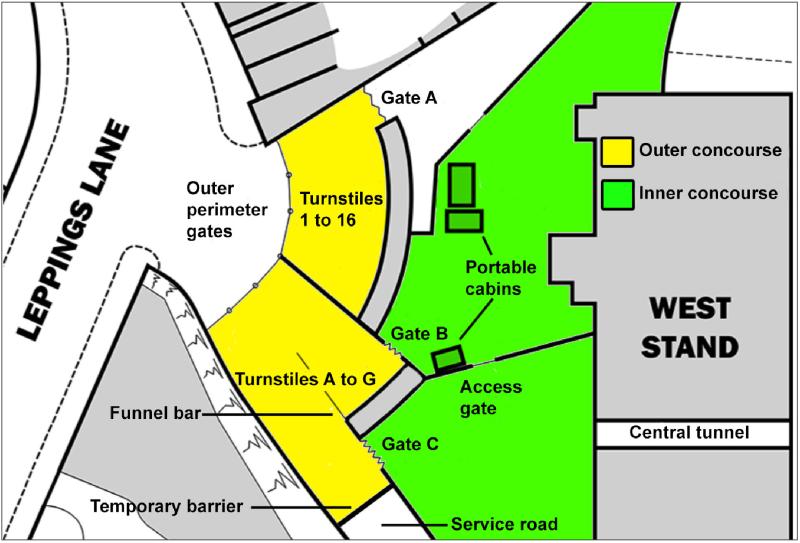
This chapter refers to numerous specific features of the Leppings Lane entrance area. These are shown in the diagram below.
Image
Figure 4A: Plan of Leppings Lane entrance area and turnstile locations (Source: Operation Resolve, based on Mr Cutlack’s diagram)
SYP asserted that its planning for the 1989 Semi-Final was largely the same as for the 1988 one. However, there were several differences that may have been significant, including the replacement of the match commander, and the lack of a joint planning meeting between SYP and SWFC meant that potentially significant information, such as the change in turnstile arrangements, may not have been communicated sufficiently to SYP. Taken as a whole, it suggests a laissez-faire and inadequate approach to planning, the disastrous consequences of which became apparent.
The crushing incidents at previous semi-finals amply demonstrated the dangers of overcrowding. The Operational Order should have not only described this risk but also set out clear responsibilities and guidance on contingencies to prevent overcrowding. This was not the case. This was one of several key issues that was not addressed within police planning, which was also poorly coordinated.
The failures of police planning were considered in complaint and conduct reports produced by Operation Resolve. The IOPC was of the view that both ACC Jackson and Supt Murray would have had a case to answer for gross misconduct, if they had still been serving, on the grounds that they failed to plan adequately for the match.
For ACC Jackson, the IOPC noted a series of failings, categorised as neglect of duty. These include that as the senior officer with overall responsibility for the planning process, he failed to ensure that learning from previous matches was properly gathered and used to inform future plans. He also failed to ensure that the Operational Order contained instructions about key issues, including how the queues to the turnstiles were to be properly supervised and how the capacity of the pens would be monitored—both of which were set out as key responsibilities in the Green Guide and other key guidance.
For Supt Murray, the IOPC identified that he would have had a case to answer for neglect of duty, for instructing officers that supporters should find their own level rather than giving explicit instructions that officers were responsible for ensuring that supporters were evenly and safely distributed across their allocated areas.
In total, there were 93 turnstiles at Hillsborough Stadium. Well over half of these were at the Spion Kop/Penistone Road end of the ground, which was where SWFC home fans would normally arrive for league games. The highest number of turnstiles provided access to the Spion Kop (the largest of the stands), but there were also turnstiles at this end that gave access to some areas of the South Stand and North Stand.
SYP had insisted that the segregation arrangements for the 1989 FA Cup Semi-Final had to replicate those used in 1988. To maintain the segregation between opposing supporters, 12 turnstiles, which would have allowed access to the North Stand from Penistone Road, were closed. Instead, all Liverpool supporters with tickets for the North Stand had to use the turnstiles at the Leppings Lane end, as did the Liverpool supporters with tickets for the West Terrace, North West Terrace and West Stand. This meant that in total, there were only 23 turnstiles available for almost 24,000 Liverpool supporters to enter the stadium. In both years, there were fewer turnstiles available at the Leppings Lane end than, according to Green Guide standards, there should have been for a crowd of that size.
However, for the 1989 game, there was a further change in the arrangements which meant that there was an additional change in the way the 23 turnstiles at the Leppings Lane end were allocated.
In 1988, 13 of the 23 turnstiles had been used to grant access to the West Stand (permitted capacity 4,465), the West Terrace (permitted capacity 7,200) and the North West Terrace (permitted capacity 2,900). So 14,565 supporters had to enter through 13 turnstiles.
For the 1989 game, 6 of these 13 turnstiles were used solely to grant access to the West Stand, with the remainder then dedicated to the West Terrace and North West Terrace. This change meant there were just seven turnstiles available to the 10,100 supporters with tickets for these areas. This equated to 1,443 supporters per turnstile. With a turnstile able to allow between 700 and 800 supporters in per hour, it would have required every turnstile to work continuously at full speed for almost two hours to let all the spectators in.
In contrast, at the Spion Kop, 21,000 supporters had 42 turnstiles through which to enter the ground, equating to 500 supporters per turnstile.
The decision to change the turnstile allocation was made by Mr Mackrell. It is not clear on what basis. Ch Supt Duckenfield did not know about the change. Supt Murray suggested he was aware of it, and understood its significance, but was uncertain when he had been told. At the Popper Inquests, he said that he had not questioned whether that was sufficient for the 10,100 supporters who needed to pass through them and that the turnstile arrangements were down to SWFC and nothing to do with him. Ch Supt Mole similarly told the Taylor Inquiry that “The arrangement for turnstiles is a matter of the Club's responsibility”.
What is certain is that SYP did not adapt its plans in 1989 to reflect the change in allocation, for example, by considering whether to permit the use of some or all of the turnstiles at the Penistone Road end that would grant access to the North Stand.
In his 1989 account for the Taylor Inquiry, Ch Insp Beal confirmed that the possibility of Liverpool supporters accessing the North Stand via turnstiles 77 to 88 on Penistone Road was considered, but it was believed that this would have presented potential public order problems.
There was no mention of the change in turnstile allocation in the Operational Order. This also meant that the supervisory officers at the Leppings Lane end were not aware of the change in advance. Many of these officers had considerable experience policing matches there and may have been better placed to identify the risk of this change.
The change to the turnstile allocation was at the heart of the prosecution of Mr Mackrell under the HSWA 1974.
Sir Peter Openshaw, the judge in the case, explained the offence as follows: “…[Mr Mackrell] failed to take reasonable care, as the Safety Officer, in respect of the arrangements for admission to the Hillsborough Stadium and particularly in respect of turnstiles being of such numbers as to admit at a rate whereby no unduly large crowds would be waiting for admission.”
Specifically, the judge stated that the charge against Mr Mackrell related to the changes he authorised between the 1988 and 1989 Semi-Finals to the allocation of the 23 turnstiles at the Leppings Lane end. The judge commented: “If the defendant had properly considered the consequences of this change of turnstile allocation which he made in 1989, he should have realised that there was an obvious risk that the so many spectators simply could not pass through just seven turnstiles in time before the kick-off; that being so, he should have realised that would cause a crowd to build up outside the turnstiles and he should have realised that that might present a risk of harm to those spectators waiting outside the grounds to pass through the turnstiles. ...that is exactly what happened.”
On 3 April 2019, the jury found Mr Mackrell guilty of failing to discharge a duty under the HSWA 1974. He was sentenced to a fine of £6,500 and ordered to pay costs of £5,000.
As set out at the start of the chapter, Ch Supt Mole ensured that Ch Supt Duckenfield was invited to the planning meeting on 22 March. However, after that, there appears to have been minimal handover or knowledge transfer before the Semi-Final.
At the Popper Inquests, Ch Supt Duckenfield said that he did not recall having a detailed discussion with Ch Supt Mole about the match. However, he said he had been assured by Ch Supt Mole that the plan was well prepared, and he had an experienced team under him making the arrangements.
In evidence at the Goldring Inquests on 10 March 2015, Ch Supt Duckenfield recalled that he arranged to see Ch Supt Mole ahead of the FA Cup Semi-Final. However, he said: “I went to see Mr Mole, expecting to have a whole day with him, and he seemed, shall we say, in my view, disappointed to be moving, wanting to clear his desk, jealously guarding his relationship, I thought, with Sheffield Wednesday, and offered me little or no advice.”
In preparation for the 1989 FA Cup Semi-Final, Ch Supt Duckenfield attended two league matches at Hillsborough Stadium.
On Saturday 1 April, he attended the game between SWFC and Millwall (attendance 18,358)
On Wednesday 5 April, he attended the evening game between SWFC and Wimbledon (attendance 15,777).
He said that he toured the stadium and spoke to some of those on duty. He could not remember exactly what he had seen or who he spoke to but said he did not see anything that concerned him.
However, he did not have any meetings with SWFC officials, who knew his predecessor in the role very well, in advance of the match. In previous years, including 1988, there had been a meeting between SWFC and SYP. It is not clear why this did not happen in 1989.
This meant that he did not have the opportunity to learn of any concerns that SWFC had, or of any changes to the SWFC planning. For example, this could have been an opportunity for SWFC to inform SYP in general, and Ch Supt Duckenfield in particular, of the change in turnstile arrangements for 1989.
In many eyes, the most significant change in the police operation for the 1989 game was that Ch Supt Mole was replaced as match commander by Ch Supt Duckenfield.
Ch Supt Mole had extensive experience overseeing police operations at Hillsborough Stadium, including being in charge of the 1987 and 1988 FA Cup Semi-Finals there. By contrast, Ch Supt Duckenfield had never commanded a match at Hillsborough Stadium or indeed commanded a match of this scale anywhere else. His experience policing football matches was limited; he had worked as an inspector at Hillsborough Stadium around a decade previously, including policing the 1980 FA Cup Semi-Final there.
He told the Taylor Inquiry that when he was a superintendent and deputy divisional commander of D Division, he had regularly policed matches at Bramall Lane, the stadium of Sheffield United Football Club (SUFC). However, at the Goldring Inquests he accepted that he only became involved in policing at Bramall Lane on the periphery, if a major match was played, and that he had never policed matches there on a regular basis.
The consequences of this change have been subject to considerable scrutiny, with numerous suggestions that if the vastly more experienced Ch Supt Mole had been in charge on the day, the disaster could have been avoided. This became more contentious when allegations emerged that Ch Supt Mole was moved from the role for disciplinary reasons.
Specifically, it has been suggested that Ch Supt Mole was moved following a ‘prank’ played on a probationary officer in the division. Though Ch Supt Mole was not in any way involved in the prank, he was the divisional commander, and this was seen as indicative of poor discipline in the division.
Operation Resolve investigated the circumstances leading up to Ch Supt Mole’s transfer and found the evidence around it is inconclusive. Senior officers close to the decision had different recollections and opinions about why he was moved. Ch Supt Mole himself told the Popper Inquests that the decision was made by CC Wright and that he had not applied for the move. However, he said that he had been divisional commander of F Division for several years and felt “the time was ripe for a move.”
CC Wright died before the Operation Resolve investigation began and had never given a public explanation for the decision. However, DCC Hayes told the Goldring Inquests that Ch Supt Mole was moved for positive career development reasons—to offer him command experience in a different location which would improve his promotion prospects. He added that the prank “was of no consequence whatever” in the decision.
ACC Jackson on the other hand told the Goldring Inquests he felt sure the prank would have been a factor.
Assistant Chief Constable Stuart Anderson (ACC Anderson) was head of staff services for SYP, which covered human resources and related issues. In a prepared statement submitted to the Solicitors to the Goldring Inquests he provided a detailed explanation of the transfer of Ch Supt Mole and the promotion of Ch Supt Duckenfield. In this, he indicated it was beneficial to both officers in career development terms, and also beneficial to the force, in terms of filling a command vacancy in B Division. He did not mention the prank.
ACC Anderson stated that the proposed transfer of Ch Supt Mole was discussed at a meeting of senior officers, where those present at the meeting “were well aware of the impending FA Cup Semi-Final”. He said that it was noted that the Operational Order had already been written, and all the same supervisory officers were in post—meaning that Ch Supt Duckenfield would not have to start the planning process. He also recalled that it was reiterated that the 1989 FA Cup Semi-Final involved the same teams that had been involved in the previous year’s fixture, which was considered to have been a success in policing terms.
Operation Resolve has found no documentary evidence of a senior officers’ meeting to support ACC Anderson’s account. Further, it does not fit the known timeline. The appointments were announced on 6 March 1989, two weeks before Hillsborough Stadium was chosen as the venue, rather than after the Operational Order was written as ACC Anderson has suggested.
Operation Resolve has also examined the appointment of Ch Supt Duckenfield, including considering his career record to that point and the appointment process. The available evidence does not suggest that the decision to appoint Ch Supt Duckenfield as the head of F Division was inappropriate in the context of the established standards and approach at that time. He had been a superintendent for around four years and had recently attended a command course. Further, the decision appears to have been made before the match was allocated to Hillsborough Stadium.
It is nonetheless clear that he lacked experience of commanding football matches of the scale of an FA Cup semi-final. Yet, due to the expectation within SYP at the time, that the divisional commander of F Division would be the main match commander at Hillsborough Stadium, he felt obliged to do so, with just a couple of weeks to prepare. At the Goldring Inquests, he was asked what he thought CC Wright’s reaction would have been if he had suggested that someone with more experience should manage the 1989 Semi-Final. He replied that he thought CC Wright would have then appointed a different officer to the role of divisional commander.
While this appears to have been the standard expectation, there was no documentary evidence that the divisional commander had to be the match commander. In fact, in an SYP document titled ‘Duties and Responsibilities of the Chief Superintendent’, there was no reference whatsoever to a chief superintendent having to take command of major events.
SYP senior officers have consistently stated they felt Ch Supt Duckenfield’s experience was adequate for the role, particularly in response to suggestions that Ch Supt Mole could have remained as match commander for one more high-profile fixture. Expert witness Mr Hopkins disagreed and felt that Ch Supt Mole should have been asked to manage the 1989 Semi-Final.
Perhaps the biggest issue therefore is not the decision to promote Ch Supt Duckenfield, but rather the internal expectation that the divisional commander of F Division would be the match commander at Hillsborough Stadium, regardless of the officer’s suitability for that role.
One of the significant changes in the SYP plans for the 1989 Semi-Final related to a change in personnel in key roles. At the 1988 game, Supt Greenwood had been the commander of sector 2, covering the arrival of Liverpool supporters and the Leppings Lane entrance. Supt Marshall had been the sector 1 commander.
For the 1989 Semi-Final, their roles were reversed. In evidence to the Popper Inquests, Supt Marshall said he had asked for the change in roles. Ch Supt Mole indicated it was his decision to switch them, to reflect the fact that Supt Marshall had regularly supervised the area outside the Leppings Lane end that season.
Ch Supt Duckenfield has confirmed he knew that Supt Marshall had not performed the role of sector 2 commander at previous semi-finals, but he said he was not aware, at the time, that the two had switched roles.
On the day of the disaster Supt Marshall assumed command of Serials 16 to 19 of sector 1, who were stationed on the outer concourse, in addition to his sector 2 responsibilities.
Both Supt Marshall and Supt Greenwood later acknowledged that this was in contravention of the F Division Operational Order. They separately explained that it was a result of their combined working experience at the 1987 and 1988 FA Cup Semi-Finals, through which both had recognised that the sector 2 commander (outside the stadium) was better placed to manage the police officers on the outer concourse prior to kick-off.
Operation Resolve has found no evidence that either Supt Marshall or Supt Greenwood reported any concern about the sector 1 commander’s difficulty in being able to manage the outer concourse as part of the debrief process following the 1988 FA Cup Semi-Final or as part of the planning process for the 1989 fixture. Nor is there any evidence that they informed Ch Supt Duckenfield of the change to command arrangements for Serials 16–19 of sector 1.
Similarly, the head of the SYP Mounted Section, Inspector Paul Hand-Davis, stated that he amended the deployment of his officers from that set out in the Operational Order, based on his own experience and knowledge of trouble spots. There is no indication that these amendments were communicated to Ch Supt Duckenfield or the PCB.
These changes highlight a lack of precision and rigour in the process, as well as a lack of coordination between the different divisions and senior officers.
Operation Resolve identified that this lack of precision extended to other issues. For example, SYP aimed to encourage supporters to arrive at the stadium as early as possible. It made announcements on local radio stations in Sheffield, Liverpool and Nottingham and published articles in local newspapers and match programmes of the competing clubs. Letters were sent to coach companies encouraging them to arrive in Sheffield early, stating that the turnstiles would be open from 11am and that pre-match entertainment and refreshments would be available inside the ground.
Yet according to the Operational Order, the turnstiles were not due to open until 12 noon and no pre-match entertainment was provided. This inconsistency resulted in arrangements having to be made at the last minute to deal with the arrival of supporters before the turnstiles opened.
More significantly, there was also a substantial reduction in the number of officers on duty. In 1988, there had been 901 staff identified on the “schedule of manpower” (a single list of the officers on duty) in the F Division Operational Order, but in 1989 there were 729 on the equivalent list. This equated to a total reduction in staff of 19%.
This was therefore a substantially greater reduction than the 10% requested by Ch Supt Mole at the start of the planning process. There is nothing to suggest that SYP recognised this or revisited officer numbers as part of its planning.
Operation Resolve further analysed staffing levels in the schedule of manpower by operational sector. This showed that the reduction in sector 2, the area covering the arrival of Liverpool supporters, was 21.6% compared to 1988. By contrast, the reduction in sector 3, covering the arrival of Nottingham Forest supporters, was 14.5%.
Although these reductions appear significant, policing expert Mr Hopkins was of the view that SYP had allocated ample resources for policing a semi-final—as long as they were deployed and managed effectively.
Other changes in the F Division Operational Order for 1989 included the decision not to use a fixed-wing aircraft or ‘spotter plane’, even though some sources indicated it had been invaluable in 1988 in identifying potential traffic issues.
The F Division Operational Order included an instruction to move any Liverpool supporters who had tickets for the Spion Kop to their own area of the ground. This was despite the fact that the match was sold out, so the West Terrace would already have been at maximum capacity.
Supt Greenwood has stated that he voiced concerns about this latter issue at the third SYP planning meeting on 10 April 1989. By this time, all the Operational Orders had been approved by ACC Jackson. The meeting was chaired by Ch Supt Duckenfield. Some of the officers in key roles on the day attended, along with representatives from D Division, Road Traffic Division and British Transport Police.
Supt Greenwood was one of the three SYP sector commanders for the match. He was in charge of sector 1, inside the stadium.
In a prepared statement given to WMP in June 1990, at the start of his interview under caution, Supt Greenwood explained that he raised the issue at the meeting “because I was concerned that the Leppings Lane end would become overcrowded if fans in such large numbers were transferred to that end.” He further explained that at the 1981 FA Cup Semi-Final, some supporters who were in the wrong end were transferred to the West Terrace, which resulted in overcrowding and crushing. He said: “When it was suggested at the second meeting that a transfer would again be necessary I raised an objection on the grounds of the 1981 incident.”
He also stated that he made Ch Supt Duckenfield, and everyone else at the meeting, aware of the importance of avoiding overcrowding and crushing on the West Terrace.
At the Goldring Inquests, Ch Supt Duckenfield said he had no recollection of a conversation with Supt Greenwood at the meeting on 10 April 1989 about the risk of overcrowding or crushing on the West Terrace. He was shown the instructions in the Operational Order and his attention was drawn to the fact that this would have resulted in the crowd on the West Terrace being over capacity. He responded that it was a defect in the Order that he had failed to see but reiterated that he had no recollection of the issue being raised at the meeting. Further, he said that at the time of the disaster he did not know about the incident of crushing at the 1981 match, or that SYP had raised concerns about the safety and capacity of the West Terrace following that incident. He said that had he been informed, he would have focused on that and taken the necessary action.
In a statement from 1990, Insp Sewell stated that he could not “…recall any comments being made regarding crushing at any previous Semi Finals or in fact at any match, or any of those present mentioning it.” He added that at no time did Supt Greenwood speak to him regarding difficulties at previous semi-finals.
PS Jones also attended the meeting and said that he recalled Supt Greenwood making a point regarding the movement of supporters within the ground, but he could not be more specific.
Supt Greenwood subsequently instructed the inspectors under his command not to transfer Liverpool supporters from the Spion Kop to the Leppings Lane end, even though he knew this was against the Operational Order.